
The Strategic Aim: Creating a Culture of Learning and Belonging
This Living Strategy has been co-created with Allied Health Leaders, our teams, stakeholders and the communities we serve. It looks to respond with thinking and practice that will support the on-going development of a culture of learning and belonging.
In this culture we are aspiring to:
- Relationships are everything; we need deep, honest, and authentic relationships with all of the people we work with, to engage with the emerging future
- Conversation, challenge, creativity and collaboration are the edges of all of the relationships in this learning environment
- You are as much the expert as I am, we are thinking equals
- Risk is shared in the adventure to explore the future and it is ok to be vulnerable
- Collectively we are the work, we are the impact, we are the role models
- Listening is paramount to self, to others and to the sense of the future
In the current culture, we recognise that in any complex setting leaders typically focus on what is in front of them. This usually results in ego led arguments about who has the ‘right’ perspective. This Living Strategy helps leaders and their teams to see that understanding the bigger system is essential to building a shared understanding of complex challenges and untapped opportunities and strengths. The work about what needs to change ‘out there’ needs to recognise what needs to change ‘in here’.
The way in which we propose this culture can be developed is through a series of reflective and more generative conversations with self, teams and the wider parts of the system. This Living Strategy makes suggestions and recommendations for leadership practice as well as engaging with emerging themes of significance from across the Allied Health Directorate.
Listening is central to this new way of being, as is letting go of entrenched mental models and assumptions. This is an essential doorway for building trust and safety. In this space, leaders and change-makers need a whole new set of skills and behaviours in the field of engagement, development and growing confidence. A mechanistic approach to developing people and teams just won’t make the kind of difference that is required. This requires us all to stop doing the thinking for others.
Developing ourselves and others to hold the development of this new system requires space to look backwards and inwards as well as forwards and outwards. We have all been part of a series of systems and we bring that history to current roles, personal patterns of communication and behaviour. The work begins with the personal inquiry ‘What do I need to learn and what do I need to let go?’ and reaches out into ‘What does the system need to let go and learn?’.
This strategy has been created by a group of senior Allied Health leaders through conversations based around the significant pillars of a culture of learning and belonging. Our strategy reflects our collective and considered responses to questions that explore the aspects of leadership and are central to creating the culture we all want for the future.
In this introductory part of the strategy, we will be looking at the following key pillars of leadership thinking and behaviour:
- Creating the Legacy we desire for the future
- Defining the Values we will use as our compass for the journey
- Considering Communication as the driver for connectedness and belonging
- Engaging with a Strengths-Based approach to learning and change
LEADERSHIP LEGACY
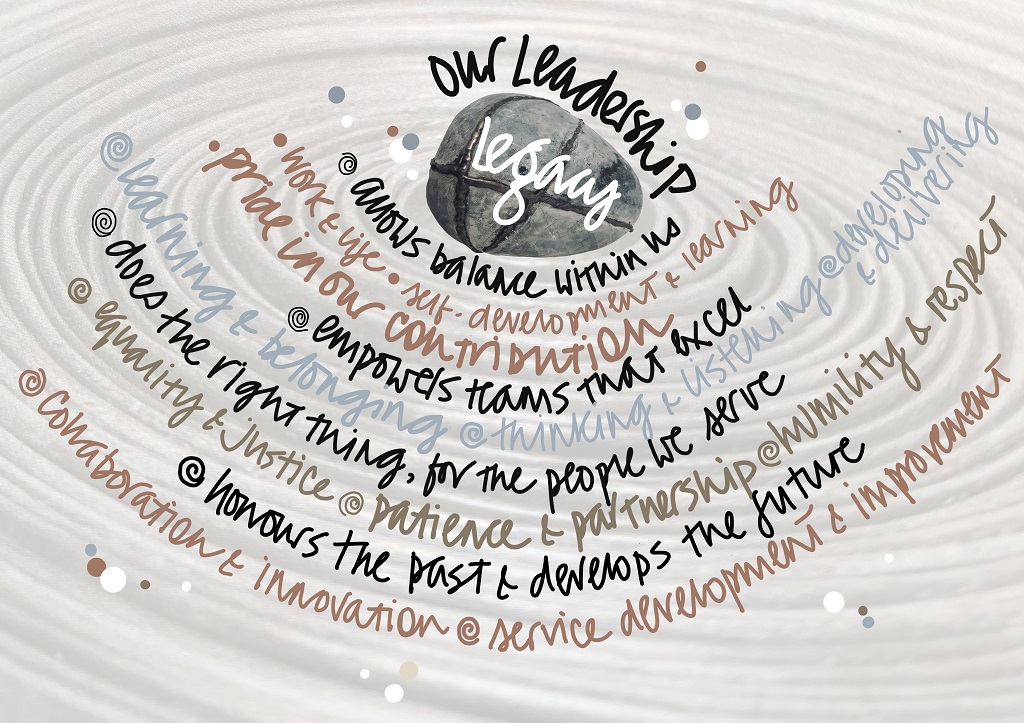
Thinking about our legacy requires us to move beyond short-term definitions of success. Legacy encompasses past, present and future. As leaders, intentionally focussing on our legacy requires us to be fully present and intentional in our thinking, our behaviour and our impact. By asking ourselves how we want to be remembered, we say that we matter and that our uniqueness can make a difference in the here and now and in the future. Our conversations surfaced a number of areas of consensus and these are explored and illustrated in the following section.
THE LEGACY OF PERSONAL VALUES AND ASPIRATIONS
All serious leadership starts from within.
- We will lead in a way that directly impacts the belonging of our people and the service we provide to our communities
- We will lead without ego and status, but from the heart and the whole
- We will lead from our core values, co-creating a shared vision
- We will communicate from our authentic self, devoting time to creating value at each opportunity
- We will grow confidence in our teams and help others find their voice: liberating thinking, feeling and potential
- We will listen with attention, with grace and with ease, valuing everyone as our thinking equal
- We will focus on our strengths to deliver the future and encourage others to do the same
THE LEGACY OF BEING SIGNIFICANT TO OTHERS
The leaders who have the most influence on us are those who are closest to us.
- We aspire to make positive and significant impacts on those around us
- We wish people to remember what we do for them and how we enable them to be successful in their own right
- We are passionate about our people and loyal to them and their emerging needs
- We develop and teach as a way of serving the people we lead
- We have open, honest and robust ways of communicating together
THE LEGACY OF RELATIONSHIPS
Leadership is a relationship between those who lead
and those who follow… leadership is personal.
- We do not take trust for granted
- We are human and so are the people we lead and those who lead us
- We have core standards and high expectations of ourselves and others and a firm and fair way of upholding those
- We will demonstrate respect and treat all that we encounter with dignity even if they see the world differently to us
- We will build competence and confidence through strong support and strong challenge
THE LEGACY OF COURAGE
Leadership is courage in action.
- We will take the initiative in moments that matter
- We will show humility and grace…serving people to become their better selves
- We will adhere to the shared, explicit rules of engagement and expectations of performance; our behaviour sets the standard for others
- We will remember our roots, why did we come into this work and is our leadership true to that vocation
- We will fail and make mistakes, especially when doing something new and different
- We will forgive ourselves and others and take the learning and move on
VALUES COMPASS
Navigating the future using our purpose and values
If legacy is what we want to leave as leaders, we need to engage with our own personal values and think about how these show up for us and guide our journey.
In her book The Values Compass, Dr Mandeep Rai reflects on her understanding of her own values and suggests the following:
- Values help us to understand ourselves, the beliefs that animate us as people and the motivation that drives our personal aspirations
- Values help us to understand other people and the source of disputes and disagreements are often rooted in a values clash and can be resolved through empathy for the contrasting perspectives
- Values help us to navigate what we want in life, providing the compass to move to become our best self
- Values help us to navigate personal and professional dilemmas and challenging decisions. They provide the core of our alignment and ultimately a meaningful life
- We will use our compass to put the patient first
- We will use our compass to actively seek ways of working together creating learning and belonging
- We will use our compass to guide our way during change and disruption
- We will use our compass and the underpinning values to hold ourselves and others to account
- We will use our compass as a reference with others
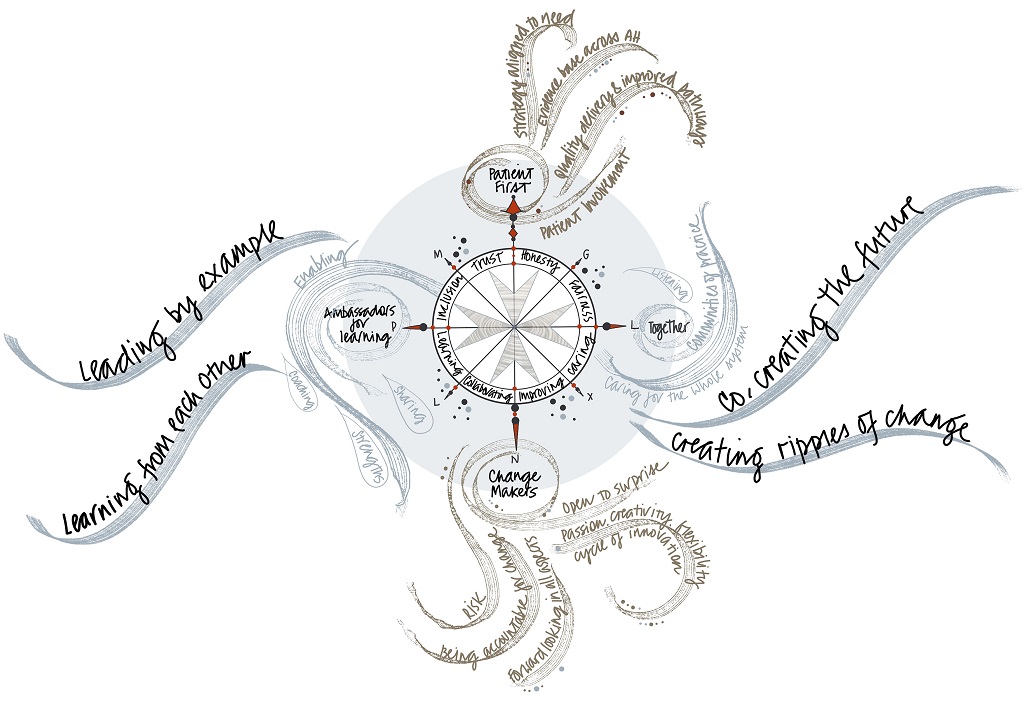
Our Values Compass
At the centre of our compass are our core values: Inclusion, Trust, Honesty, Fairness, Learning, Collaborating, Improving and Caring. These define our core motivations in the work that we do.
We recognise that our values come from different places and parts of our lives. Some are taught and handed down, some are acquired through experience and some are aspirational. A value can be intrinsic or adopted. The most important aspect is that these values feel true to us as a group of Allied Health leaders, both about how we are and how we aspire to be.
COMMUNICATION
Changing the culture one conversation at a time
We all know that without communication, nothing gets done. We also understand that the quality of the communication is critical in terms of creating the culture of learning and belonging we desire. Often in the busy world of task and target, we are not fully present in our communication and may resort to telling rather than engaging in a misplaced belief that it is quicker. This is completely counter-intuitive and does not build the relationships that create belonging and engagement and, therefore, directly impact performance and patient care.
This strategy lays out our ambitions for our communication, where we co-create space to listen and to untap the potential that exists within the layers of our people. This requires a focus on listening for emotions, feelings, ideas and potential as well as facts, data and information. Equally, this requires leaders to ask different kinds of questions.
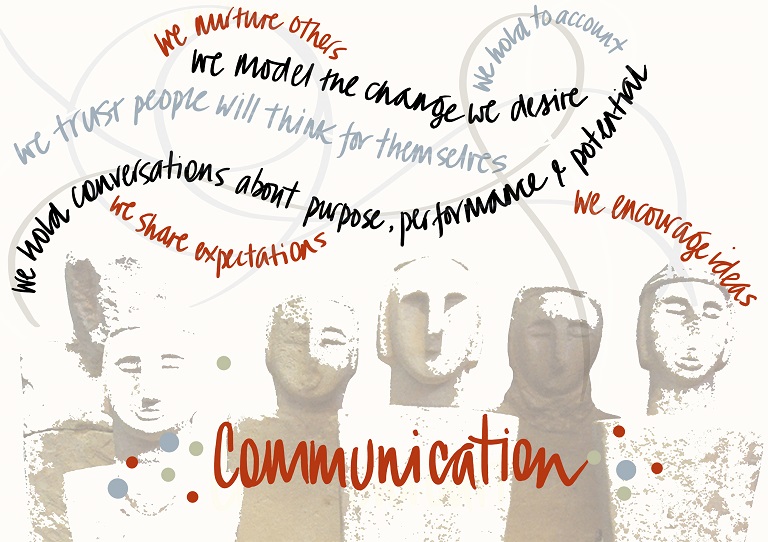
- We will step away from our desire to over control everything, trusting people can and will think for themselves if that space is created
- We will transform ‘meetings’ to conversations about purpose, performance and potential
- We will engage our desire to nurture others as a way of listening with attention, grace and ease, and providing person-centred reflection and development conversations
- We will share expectations in an assertive and fair way, including boundaries around performance and behaviour
- We will hold each other to account through the creation of an adult-adult feedback culture
- We will actively discourage and address indirect communication and behaviour that undermines the team and the culture change we desire
- We will encourage ideas from others in a genuine and meaningful way, creating space for conversations about innovation and change
STRENGTHS
Strengths Culture
The concept of a culture built on strengths is about the search for what gives life to people, their organisations, and the world around them. In its broadest sense, the focus on strengths involves the discovery of everything that supports a system when it is most vibrant. This is a comfortable fit with our aim of Creating a Culture of Learning and Belonging.
This approach requires us as leaders to harness the strengths of individuals and the positive potential of the team and the wider organisation in an intentional and disciplined way. This enables a positive and affirmative way of convening around greater meanings and shared goals. This enables generative conversations and opening the system to better and more valued possibilities.
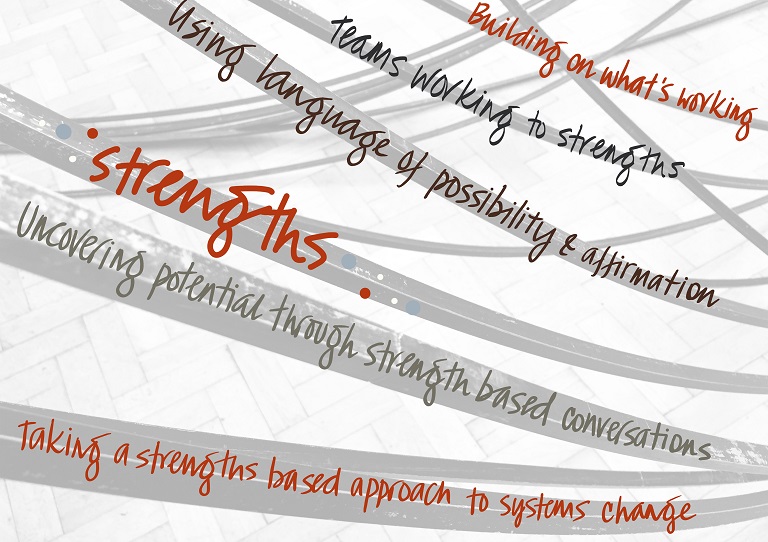
- We will discover the strengths within our teams and supporting individuals to work to their strengths
- We will spend as much time building on what is working as we do on what is stuck
- We will rebalance our language around what’s possible and what’s affirming
- We will provide opportunities as part of business as usual to focus on strengths
- We will uncover the untapped potential within our teams through developing people’s strengths
- We will utilise a strengths-based approach to change and challenge within the system
REFLECTIVE PRACTICE
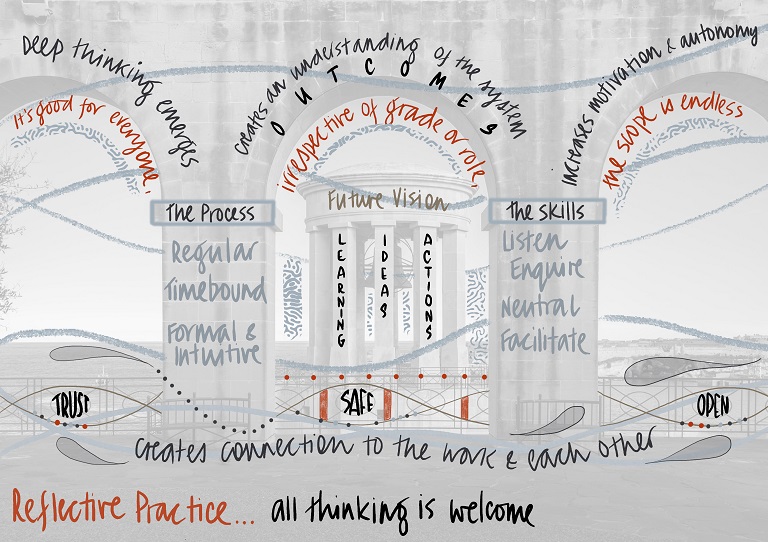
Connecting people to their thinking, learning and the future
Reflective Practice is the foundation of personal, professional and clinical development; it makes meaning from experience and transforms insights into practical strategies for personal growth and organisational impact.
It involves integrating activities into daily life on a routine basis, raising awareness, prompting critical analysis and aiding self-management and decision-making. It means:
As people, we have a unique set of experiences, mental models and assumptions. Restructuring and re-ordering what is known requires active, engaged participation in the learning process, and relating ideas and concepts to personal experience. Research shows that for this to happen the new knowledge needs to be of practical and personal value to the person reflecting.
Reflection deepens learning. The act of reflecting enables us to make sense of what we’ve learned, why we learned it, and how each increment of learning took place. Moreover, reflection is about linking one increment to the wider perspective of learning – heading towards seeing the bigger picture. Through reflection, learning is integrated, internalised and personalised.
Thinking about an experience is essentially a cognitive activity, but reflection is also emotional and physical, and is linked with our values and social identity. Viewing issues from different perspectives challenges assumptions and established patterns of behaviour and encourages the development of new ways of seeing.
Transformational theories suggest that adult learning is principally a meaning-making activity; that acquiring job-specific skills and spending time on continuous development creates the opportunity to gain a deeper understanding of oneself as a learner and acquire a body of knowledge.
- We will create space for our own reflective practice as leaders, both with our Thinking Partners and our wider Leadership Community
- We will facilitate the creation of space and time for the teams and individuals that we lead to reflect: this can be formal or informal
- We will embed the idea and practice around reflection in our teams
- We will support our teams to learn how to facilitate reflective practice conversations with each other
TEAMS AS COMMUNITIES
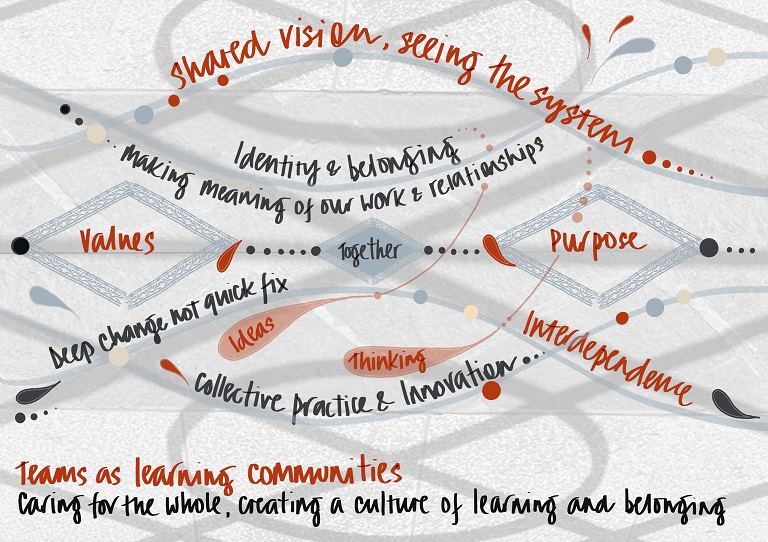
The ideas of teams in organisations is not new, the concept that as a collective we can deliver more for the people who use our services. In their current form, many of these ways of organising are very effective. However, it is also apparent in organisations like health and care systems that this is not always the case. The footprint of hierarchical over situational leadership, professional qualifications over practice, and telling rather than listening all impact on the efficacy of the ‘Multi-Disciplinary Team’.
The idea of the team as a Community of Practice with shared purpose and a passion for joint working is an antidote to the more traditional concept around team and structure. Communities of Practice nurture learning and belonging and are therefore aligned in thinking and practice to this Living Leadership Strategy. Communities of Practice use creative and emergent ways of listening, generating thinking and ideas and planning the way forward. Knowledge is shared in creative ways, and building the community almost inadvertently impacts performance and engagement.
Health Care Communities of Practice: Strategic Commitments
We recognise that new ways of listening, learning, and working together are required for us as an AHP Directorate to meet our full potential. We also understand that the concept of Communities of Practice cannot be ‘implemented’ in the usual way: it is not an initiative to be driven but an idea to be nurtured. To create the environment where this is possible:
- We will identify potential communities of practice that will enhance service delivery, learning and belonging
- We will provide support and infrastructure to support these teams based on what they identify as their needs
- We will use conversation and inquiry to evaluate the impact of these teams to service delivery, learning and belonging
Health Care Communities of Practice: Operational Commitments
- We will value potential communities of practice through listening to their stories, identifying themes and making change from there
- We will invest time sharing learning and building belonging
- We will develop team members to support their capacity to share learning and build belonging
RELATIONSHIP-CENTRED CARE
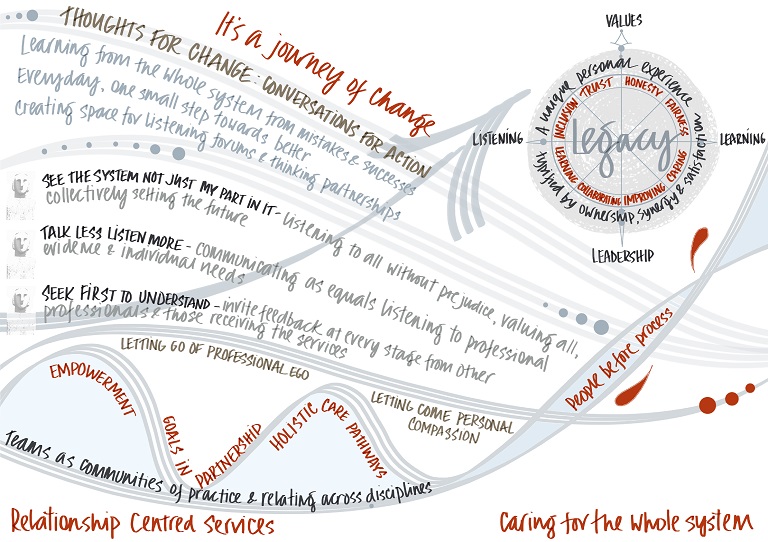
- We aspire to make positive and significant impacts on those around us and those we serve
- We are passionate about people and listen to them and their emerging needs
- We develop and teach as a way of serving the people we lead
- We have open, honest and robust ways of communicating together within teams and with people we care for
- We will show humility and grace… serving people to become their better selves
- We will adhere to the shared, explicit rules of engagement and expectations of performance; our behaviour sets the standard for others
- We will remember our roots: why we came into this work and whether our leadership is true to that vocation