
In the 18th Century, Robert Burns penned the line “O wad some Power the giftie gie us, to see ourselves as others see us!” Or, in modern English, “What if we had the gift of feedback to see ourselves as others do?”
This idea is at the centre of personal development and growth: How do we learn about our impact, how do we ask for feedback, how do we self-reflect? This selection of tools and frameworks will enable you to start to think about this in ways that can support and grow strengths and to identify areas for personal change.
The deep changes necessary to accelerate progress against Allied Health’s most embedded patterns of being requires leaders and change makers who energise a collective response. The days of hierarchical charismatic leaderships are gone. Leaders can no longer be the smartest people in the room. This historical leadership paradigm creates learned helplessness, a lack of personal responsibility, pride, and a fundamental lack of belonging.
The system you desire calls for something much more connected, more considered and more collaborative. This kind of leadership and change-making is concerned with the system as a whole, with all of its entanglements, history and complexity, and doesn’t aim for a ‘quick fix’ but for a transition towards better. This transition is built on the fundamental cornerstones of belonging: trust, truth and safety.
Developing leaders and change makers to hold the development of this new system requires space to look backwards and inwards as well as forwards and outwards. We have all been part of a series of systems and we bring that history to current roles, personal patterns of communication and behaviour. The work begins with the personal inquiry ‘What do I need to learn and what do I need to let go?’, ‘How do I see myself in the system?’, ‘What’s my role in where I find myself?’
Appreciative Inquiry with Line Manager
Learning Intention: Explore and reflect on strengths and potential with your line manager
Inquiry
“The important thing is not to stop questioning; curiosity has its own reason for existing. Most people waste their time by asking questions that are intended to discover what a pupil does not know, whereas the true art of questioning is to discover what the other does know or is capable of knowing.” – Einstein
Questions are more transformative than answers and are essential tools of engagement. Questions create the space for something new to emerge. However, in the busy world of task, target, fix it and sort it, answers are still valued more than questions and in the short term often feel easier. Answers, especially those that respond to our need for quick results, while satisfying, shut down the discussion and the future shuts down with them.
As leaders, what does this mean for our practice and how we ask questions?
Time has been called on the old-fashioned patterns of questions that many of us have been trained in and trained others to use. The processes we used 10 years ago are not fit for the unprecedented times of uncertainty and austerity that organisations find themselves in. We need to change.
For 10 years, I have explored a variety of models that come at questions from a different perspective. These include Appreciative Inquiry, Thinking Environments and Systems Thinking.
This process of you interviewing your line manager aims to capture your curiosity and support you to join the journey to discover powerful and generative questions – ones that not only change the conversation but also change the future.
Guidance
You will need 30-45 minutes; on no account should this be done on an email. Make sure you get the appointment in place with the line manager as soon as the programme goes live. Be mindful that you are there to inquire into the thinking of your line manager, not the other way around.
It might be good to record the interview if your line manager is willing, which means you can be fully present and not distracted in terms of note-taking. Make sure you are appreciative of their time and that you have a format and a pattern of questions you will be using. Depending on their thinking preferences, they might like to see the questions beforehand.
Afterwards, listen to the recording and pull out what you think are the most important insights for you personally.
Questions
- When you think about my strengths as a leader, what comes to mind?
- When have you seen me work well across the Allied Health System?
- In your view, in the context of my leadership, what do I need to let go of and what do I need to learn?
- If this programme was to help me shift my impact, what would you like to see and how can you support me?
Remember to end with appreciation and let your line manager know that you may come back with further inquiry as the programme progresses.
Finally, make some notes about what you have learned as a result of the process, the conversation and the impact moving forward.
Bring your reflections of the line manager interview to the first ALS after induction, where this will be explored.
Personal Leadership Compass
Learning Intention: Define the components of your leadership compass, reflecting on strengths, values and desired legacy
Creativity
A recent IBM study of more than 1500 CEOs reports that the single most important leadership competency for leaders in the complex systems of today and tomorrow is creativity. They also discovered that many leaders are insecure around the idea of creativity, believing that they are not the creative type.
My experience is that this thinking can be unblocked and enabling leaders to do so can have far-reaching implications for them, their organisations, families, and the wider community.
To begin, leaders need to let go of the internal voice of judgement that says “I’m not good at this sort of thing”. This is not about being an artist: if you have ever solved a problem, found a way around something, baked a cake or built a sandcastle, then you are creative. Trust the process. What’s the worst thing that can happen?
Guidance
There is no time limit on this. You might make a start and then come back to it; it is your choice.
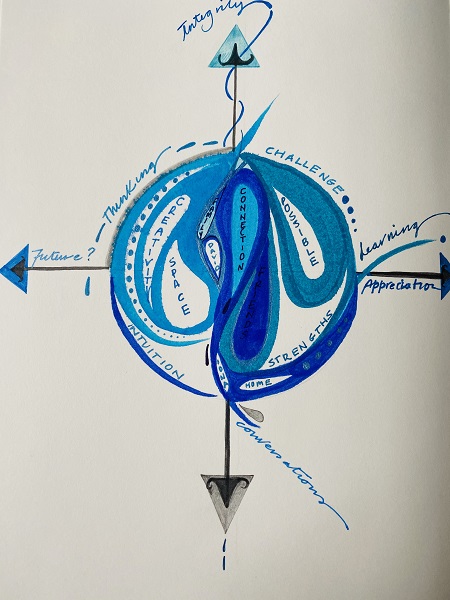
The Leadership Compass is an invitation into a safe, creative space. What follows is guidance, not a process or set of rules, more like some tips and thoughts. I have provided you with my compass and its story on the following pages in the spirit of shared learning, not as an exemplar.
Create your compass in whatever size you like, as long as it can be photographed and read as part of a collective artefact. As a rule of thumb, I would say no smaller than A4.
One leader who loved scrap metal built something, another baked a cake! It’s the making that matters: collage, drawing, sewing, whatever. Just manifest your thinking in a visual way. The only rule is no PowerPoint and no computer-generated images! No one will die! Leadership is about stepping into the unknown…
Questions that could help
- How do you ‘show-up’ as a leader in your whole life?
- Who and what keeps you ‘straight’?
- What values guide you?
- What would you like to think your leadership legacy will be?
Overview
When I was thinking about my Leadership Compass, I was thinking about what and who keeps me ‘straight’ on my journey. I see this as a whole life thing, not just how I lead myself and others in a work context, but how I ‘show up’ as a leader in all aspects of my life. This is to do with who I am in all relationships, and accepting that how I use the compass to navigate these relationships will be different.
The Design
I started with the basic compass shape. The four points of the compass are what I think you will see in my behaviour as a constant.
Blue symbolises calm, and the blues I have chosen are reminiscent of the blues I see in the water around the West coast of Scotland.
The shapes are more fluid than rigid. I’m not great with too many rules, although I think there is a need for some structure to hold things together.
The Words
Centrally, the words show my connection to David, my family, my friends, and the Island of Iona (maternal heritage). Without these people and places, I would be adrift. They are at the heart of my compass. The other words inside and outside the circle, describe what I think I do with my leadership and how I engage others, on my and their own leadership journey.
Reality
Of course, none of this means that I don’t make mistakes, get lost on the road, or take a path in spite of the compass: this is the human condition. However, having the compass and sharing it with you gives me a chance to show some of my vulnerability and strengths, and provides a framework for self and peer reflection.
Importantly, on this journey, I see you all as my thinking equals: my thinking is not more important than yours, only different.
On completion of this activity, send a jpeg image (photo) as an attachment to Fiona by 15.02.21, and this will form part of the Thinking Space Slideshow.